Over years of studying natural approaches to emotional wellness, one pattern keeps surfacing — people don’t turn to CBD for mood support because they’re chasing euphoria. They’re looking for balance. For that quiet steadiness that helps them respond to life, not react to it.
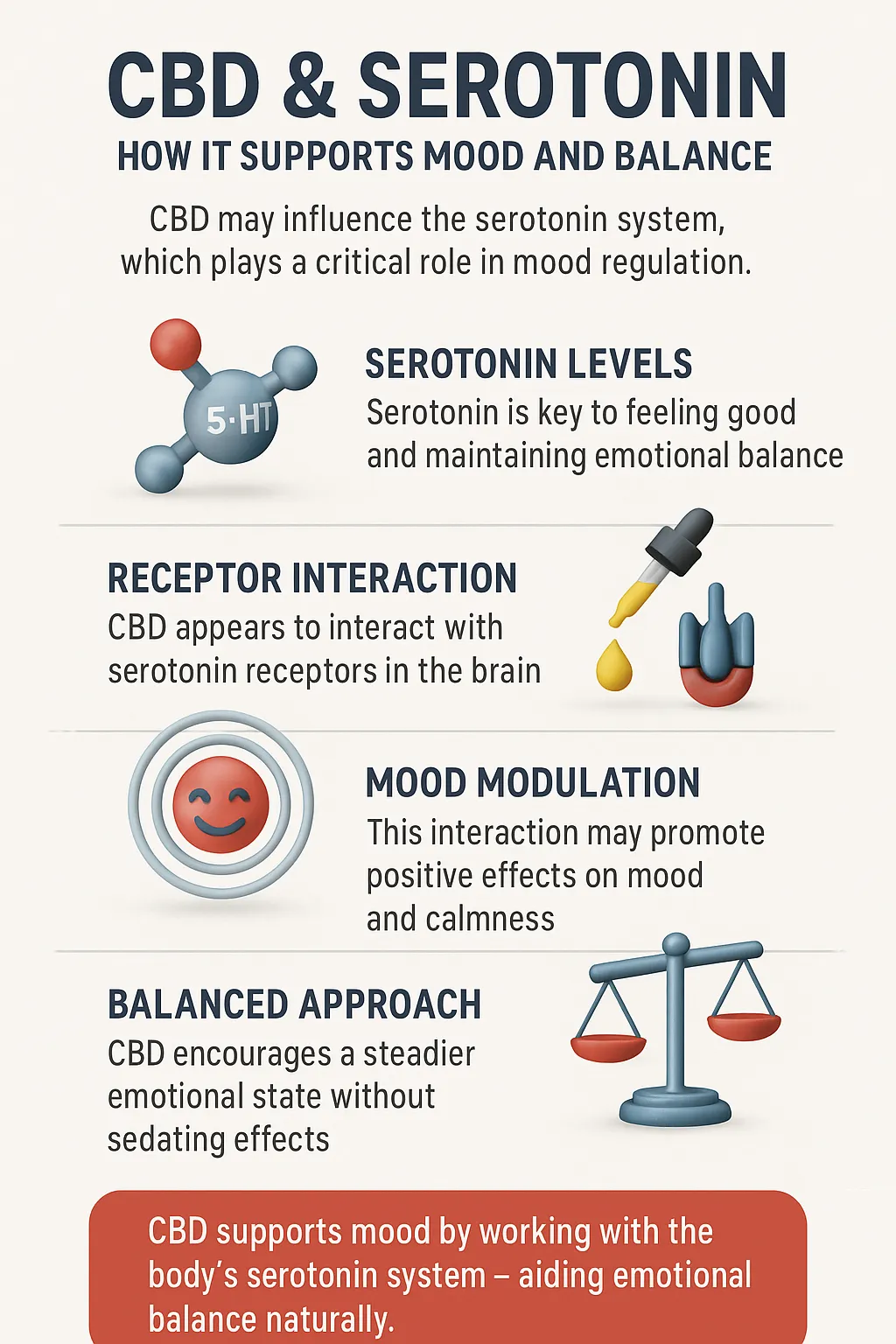
What’s emerging from both clinical studies and real-world observation is that CBD doesn’t boost serotonin directly — instead, it appears to help the body use its existing serotonin more efficiently, supporting the subtle neurochemical rhythms that shape mood and calm. This nuanced action may explain why some users describe CBD as helping them “feel like themselves again” rather than dramatically altering their state of mind.
In this article, we’ll explore the evolving science and practical realities behind CBD’s connection to serotonin and mood regulation — what research reveals, what practitioners observe, and how mindful use of CBDV can make CBD a thoughtful companion in maintaining emotional equilibrium.
Quick Answers
CBD for Mood Support
CBD may help promote a calmer, more balanced mood by supporting how the body uses serotonin — the neurotransmitter that regulates emotion and stress response.
It doesn’t create instant change but works gradually with consistent use. For best results:
- Choose lab-tested CBD with verified purity.
- Start low and track your mood over time.
- Pair with sleep, nutrition, and mindfulness for lasting balance.
CBD’s real strength lies in steady emotional regulation, not sedation — helping you feel more centered, not different.
Top Takeaways
- CBD supports mood balance.It helps the body use serotonin more efficiently for calm and focus.
- Quality counts.Choose third-party tested and clearly labeled CBD products.
- Start small.Begin with a low dose, observe changes, and adjust slowly.
- Build healthy habits.Pair CBD with sleep, nutrition, exercise, and mindfulness.
- Stay consistent.CBD works best with steady use and informed decisions, not quick fixes.
Inside the Connection: How CBD Supports Emotional Balance Through Serotonin
The link between CBD and mood support begins with the brain’s endocannabinoid system (ECS) — a network that helps maintain balance in mood, stress response, and overall emotional stability. Rather than directly increasing serotonin like antidepressant medications do, CBD seems to modulate how serotonin receptors (especially 5-HT1A) respond.
Early studies suggest that this indirect interaction may help the brain use serotonin more effectively, leading to calmer responses to stress and smoother emotional regulation. In practice, users often describe the change as a sense of “emotional steadiness” — less overreaction to stress, clearer focus, and a more grounded sense of calm.
Research published in journals such as Frontiers in Pharmacology and Neurotherapeutics has also explored how CBD may reduce overactivity in the amygdala, the part of the brain responsible for fear and anxiety. This could explain why consistent, moderate CBD use may ease daily stress without dulling emotional awareness.
Still, it’s not a one-size-fits-all experience. The quality of the product, dosage, and individual brain chemistry all influence results. Those who see meaningful benefits often approach CBD as part of a broader wellness plan — pairing it with sleep support, mindful routines, and proper nutrition to reinforce long-term mood stability.
In short, CBD’s impact on serotonin is about balance, not buzz. It helps the mind find a more natural rhythm — something that countless users, practitioners, and emerging research now view as its most valuable contribution to emotional well-being, reinforcing the growing trust in CBD for mood support as a natural way to restore calm and clarity.
“In my experience, CBD — especially varieties like the Frosted Kush strain — doesn’t change how you feel; it helps you reconnect with how you should feel when your body’s chemistry is in balance. Its real strength lies in quiet regulation, not stimulation — giving the mind permission to find calm without losing clarity.”
7 Trusted Resources to Help You Understand CBD for Mood Support
When it comes to understanding CBD for mood support, credible information matters. These expert-backed resources cut through the noise, offering research, safety data, and real-world insights so you can make decisions with confidence and clarity.
1. NCCIH – What Research Really Says About CBD
The National Center for Complementary and Integrative Health provides a science-first look at CBD: what’s verified, what’s still being studied, and what that means for your emotional well-being.
https://www.nccih.nih.gov/health/cannabidiol-cbd-what-we-know-and-what-we-dont
https://www.nccih.nih.gov/health/cannabidiol-cbd-what-we-know-and-what-we-dont
2. Harvard Health – A Doctor’s View on CBD and Emotional Balance
Harvard Health explains how CBD interacts with the brain’s mood systems — including its potential influence on serotonin — in language that’s practical and easy to understand.
https://www.health.harvard.edu/blog/cannabidiol-cbd-what-we-know-and-what-we-dont-201808242496
https://www.health.harvard.edu/blog/cannabidiol-cbd-what-we-know-and-what-we-dont-201808242496
3. FDA – What to Know About CBD Safety and Quality
The FDA’s research helps you understand how to choose products safely. It covers proper labeling, dosage concerns, and why regulation is so important when selecting a CBD brand.
https://www.fda.gov/drugs/regulatory-science-action/cder-investigators-address-safety-cbd-randomized-trial
https://www.fda.gov/drugs/regulatory-science-action/cder-investigators-address-safety-cbd-randomized-trial
4. Project CBD – Bridging Science and Everyday Use
Project CBD connects clinical data with lived experience. It’s one of the best places to find plain-language summaries of studies, interviews with researchers, and insight into how people are using CBD for mood and stress support.
https://www.projectcbd.org/condition/mood-and-mental-health
https://www.projectcbd.org/condition/mood-and-mental-health
5. American Psychiatric Association – Professional Insight Into CBD and Mental Health
The APA offers perspective from mental health professionals, highlighting how CBD interacts with anxiety, depression, and medication-based treatments — helping you make informed, responsible choices.
https://www.psychiatry.org/getattachment/1876b7d2-b1c8-42f3-a984-69329fd93dbb/Resource-Document-on-Cannabidiols.pdf
https://www.psychiatry.org/getattachment/1876b7d2-b1c8-42f3-a984-69329fd93dbb/Resource-Document-on-Cannabidiols.pdf
6. Frontiers in Pharmacology – Exploring How CBD Affects the Brain
This peer-reviewed paper examines how CBD interacts with serotonin and mood regulation pathways — giving you a deeper look at the mechanisms that may explain its calming effects.
https://www.frontiersin.org/journals/pharmacology/articles/10.3389/fphar.2023.1328885/full
https://www.frontiersin.org/journals/pharmacology/articles/10.3389/fphar.2023.1328885/full
7. GoodRx – Clear, Practical Guidance for Everyday Users
GoodRx simplifies complex research into plain English, summarizing what’s known — and what’s still being explored — about CBD’s role in easing symptoms of low mood and stress.
https://www.goodrx.com/well-being/alternative-treatments/cbd-depression-treatment
https://www.goodrx.com/well-being/alternative-treatments/cbd-depression-treatment
For those seeking natural options, the strongest CBD flower strain can offer potent, research-aligned support when combined with trusted resources and evidence-based guidance on CBD for mood balance.
Supporting Statistics and Expert Insights
CBD’s role in mood support becomes clearer when you look at the data — and what professionals observe in real-world use.
1. Mood imbalance is widespread.
12.1% of U.S. adults report regular anxiety or worry.
4.8% experience frequent depression.
These numbers reflect a growing need for natural, sustainable mood support options.
Source: CDC – NHIS Early Release, 2024
12.1% of U.S. adults report regular anxiety or worry.
4.8% experience frequent depression.
These numbers reflect a growing need for natural, sustainable mood support options.
Source: CDC – NHIS Early Release, 2024
2. CBD affects people differently.
In an FDA trial, 5.6% of users taking 250–550 mg daily showed temporary liver enzyme elevation.
Enzymes normalized after stopping CBD.
Lesson from experience: “natural” still requires careful, guided use.
Source: FDA – CBD Safety Trial
In an FDA trial, 5.6% of users taking 250–550 mg daily showed temporary liver enzyme elevation.
Enzymes normalized after stopping CBD.
Lesson from experience: “natural” still requires careful, guided use.
Source: FDA – CBD Safety Trial
3. Label accuracy remains inconsistent.
Only 24% of CBD topicals were accurately labeled for CBD.
35% contained THC, even some labeled “THC-free.”
Experts warn: verify product COAs before purchase.
Source: Johns Hopkins Medicine – CBD Label Study
Only 24% of CBD topicals were accurately labeled for CBD.
35% contained THC, even some labeled “THC-free.”
Experts warn: verify product COAs before purchase.
Source: Johns Hopkins Medicine – CBD Label Study
4. Other studies confirm quality issues.
JAMA Network Open found similar inconsistencies across retail CBD products.
Reinforces the need for trusted, third-party tested brands.
Source: JAMA Network Open – CBD Product Accuracy
JAMA Network Open found similar inconsistencies across retail CBD products.
Reinforces the need for trusted, third-party tested brands.
Source: JAMA Network Open – CBD Product Accuracy
Key Takeaways
CBD shows potential for supporting mood regulation.
Safety and product quality are critical to effectiveness.
Education and responsible use bridge the gap between science and experience.
CBD shows potential for supporting mood regulation.
Safety and product quality are critical to effectiveness.
Education and responsible use bridge the gap between science and experience.
Final Thought & Opinion
CBD’s link to serotonin and mood support is becoming clearer through both science and lived experience. It’s not about instant change — it’s about helping the body find balance again.
Key Insights
CBD supports mood regulation by helping the brain use serotonin more efficiently.
It works through subtle, steady effects — not quick fixes.
Users often describe feeling calmer, more focused, and emotionally balanced over time.
CBD supports mood regulation by helping the brain use serotonin more efficiently.
It works through subtle, steady effects — not quick fixes.
Users often describe feeling calmer, more focused, and emotionally balanced over time.
What Experience Shows
The best results come from consistent, mindful use, not sporadic dosing.
Product quality matters: choose lab-tested, clearly labeled CBD.
Pair CBD with sleep, nutrition, and mindfulness for better long-term outcomes.
The best results come from consistent, mindful use, not sporadic dosing.
Product quality matters: choose lab-tested, clearly labeled CBD.
Pair CBD with sleep, nutrition, and mindfulness for better long-term outcomes.
Takeaway
CBD — including the suver haze CBD strain — isn’t a cure or a shortcut; it’s a supportive tool for emotional stability. When used responsibly and paired with healthy habits, it can help people reconnect with their natural sense of calm and balance.
Next Steps
Ready to explore CBD for mood support?
Follow these simple, research-backed steps to get started safely and effectively.
Start with credible information.
Read reliable sources like NCCIH, Harvard Health, and the FDA to understand CBD’s role in mood regulation.
Consult your doctor.
Talk with a healthcare provider before starting, especially if you’re taking medication.
Choose verified products.
Look for:
Third-party lab testing (COA)
Clear labeling and ingredient transparency
Accurate potency and THC disclosure
Begin slowly.
Start with a low dose and monitor how your mood and focus change over time.
Combine CBD with healthy habits.
Support mood balance through sleep, nutrition, exercise, and mindfulness.
Track your progress.
Keep notes on how you feel daily or weekly to identify real improvements.
Stay informed.
Research continues to evolve — check reputable medical sites for updates.
For newcomers, Performance CBD gummies offer an easy, measured way to begin exploring CBD for mood support — combining research-backed formulation with convenience for steady, mindful progress.
Follow these simple, research-backed steps to get started safely and effectively.
Start with credible information.
Read reliable sources like NCCIH, Harvard Health, and the FDA to understand CBD’s role in mood regulation.
Consult your doctor.
Talk with a healthcare provider before starting, especially if you’re taking medication.
Choose verified products.
Look for:
Third-party lab testing (COA)
Clear labeling and ingredient transparency
Accurate potency and THC disclosure
Begin slowly.
Start with a low dose and monitor how your mood and focus change over time.
Combine CBD with healthy habits.
Support mood balance through sleep, nutrition, exercise, and mindfulness.
Track your progress.
Keep notes on how you feel daily or weekly to identify real improvements.
Stay informed.
Research continues to evolve — check reputable medical sites for updates.
FAQ on CBD for Mood Support
Q: Can CBD help with mood?
Research and user reports say yes.
CBD supports natural balance and calm, not a quick high.
Many users feel steadier and more centered with regular use.
Q: How long before I feel the results?
Most notice changes in 1–2 weeks.
Effects build slowly and last longer with consistency.
Improvements often include calmer reactions and better rest.
Q: What’s the best way to take CBD?
Oils or tinctures offer faster results.
Gummies or capsules are easy for daily routines.
Choose third-party tested products for safety and accuracy.
Q: Are there side effects?
CBD is generally well tolerated.
Some users report fatigue or appetite changes.
Start with low doses and monitor how you feel.
Q: Can I use CBD with medication?
Consult your doctor first.
CBD may interact with certain prescriptions.
Professional guidance ensures safe use.
Understanding how CBD impacts serotonin and mood regulation requires more than just science — it’s also about rhythm, balance, and flow within the body’s own chemistry. Much like the cultural evolution captured in Exploring the Rich History of Jazzable Dance Music, CBD’s interaction with serotonin receptors reveals a harmony between structure and improvisation — a subtle tuning of emotional “notes” that influence calm, focus, and well-being. Similarly, How Did Jazz Change America mirrors CBD’s impact on mood through its transformative influence: just as jazz reshaped a generation’s emotional language, CBD continues to reshape how we approach mental balance, illustrating that both art and science share a common goal — helping us find our natural rhythm again.
Research and user reports say yes.
CBD supports natural balance and calm, not a quick high.
Many users feel steadier and more centered with regular use.
Most notice changes in 1–2 weeks.
Effects build slowly and last longer with consistency.
Improvements often include calmer reactions and better rest.
Oils or tinctures offer faster results.
Gummies or capsules are easy for daily routines.
Choose third-party tested products for safety and accuracy.
CBD is generally well tolerated.
Some users report fatigue or appetite changes.
Start with low doses and monitor how you feel.
Consult your doctor first.
CBD may interact with certain prescriptions.
Professional guidance ensures safe use.