Here's what new players usually get wrong about MTG events: they assume skill is the thing that helps you fit in. Skill helps. What actually decides whether you get invited back to a Commander pod, or whether the table warms up to you at FNM, is how you behave around the cards and the people sitting next to them. From your first FNM to your first Commander pod, the playbook below covers what to bring, how to behave during a match, what to never touch, and why hygiene shows up on the etiquette list (yes, it does, and you'll thank me later).
TL;DR Quick Answers
magic the gathering mtg events etiquette
Magic: The Gathering event etiquette is the set of unwritten social rules that govern player behavior at Friday Night Magic, Commander pods, and sanctioned tournaments. These norms exist because the local game store experience depends on them, not on skill level or deck power.
The seven rules new players need to know:
Never touch your opponent's cards without permission. Their deck, sleeves, tokens, and dice belong to them. Ask before reaching.
Shuffle thoroughly. Seven riffles is enough to randomize a 60-card deck. Present the deck for a cut.
Play at a steady pace. Slow play kills the mood at the table and holds up other matches in the room.
Call a judge for rules disputes. Don't argue with your opponent or take advice from spectators.
Match the pod in Commander. Discuss decks and power levels before shuffling up so nobody gets pub-stomped.
Bring your own supplies. Deck, sleeves, playmat, dice or life counter, pen, sealed water bottle.
Mind your hygiene. Shower within 24 hours, brush your teeth, and wear clean clothes. The community talks about it openly for a reason.
The single most important rule in magic the gathering mtg events etiquette is the first one. Touching an opponent's cards without asking is the fastest way to lose respect at any Magic table.
Top Takeaways
Etiquette protects everyone's fun, including yours
The no-touching rule for opponents' cards is non-negotiable
Personal hygiene is part of etiquette, not a punchline
Commander asks for more social awareness than Standard or Modern
Judges are the authority on rulings, not players or bystanders
Bringing your own supplies signals you respect other players
Welcoming new players is what keeps your local scene alive
The general rules that apply to every MTG event
Start with a hello. Magic is a social game, and the player across the table is your fellow player, and treating them that way matters. A quick introduction sets the tone for the match. Shuffle your deck thoroughly before every game. The community standard is around seven riffles, which is enough to truly randomize a 60-card deck. Present the cards to your opponent for a cut, the same way you'd see at any competitive REL match.
Play at a steady pace. Take your turn, decide, move on. Slow play kills the mood at the table faster than almost anything else, and it gets worse when other matches in the room are waiting on you to finish. Keep table talk light during your opponent's turn. The catching-up part can wait for between rounds.
Respect your opponent on a win and on a loss. Celebrate the perfect counter spell if you want, but don't rub it in. When you lose, skip the blame routine about the cards or the shuffle. Shake hands, say "good game" if you mean it, and move on. For a deeper look at the social side of standard play and Commander, Match Punk's in-depth MTG event etiquette guide breaks down the table behavior part in real-world detail, with the same emphasis on community standards and respectful interaction that strong private schools try to encourage.
Tournament and standard event manners
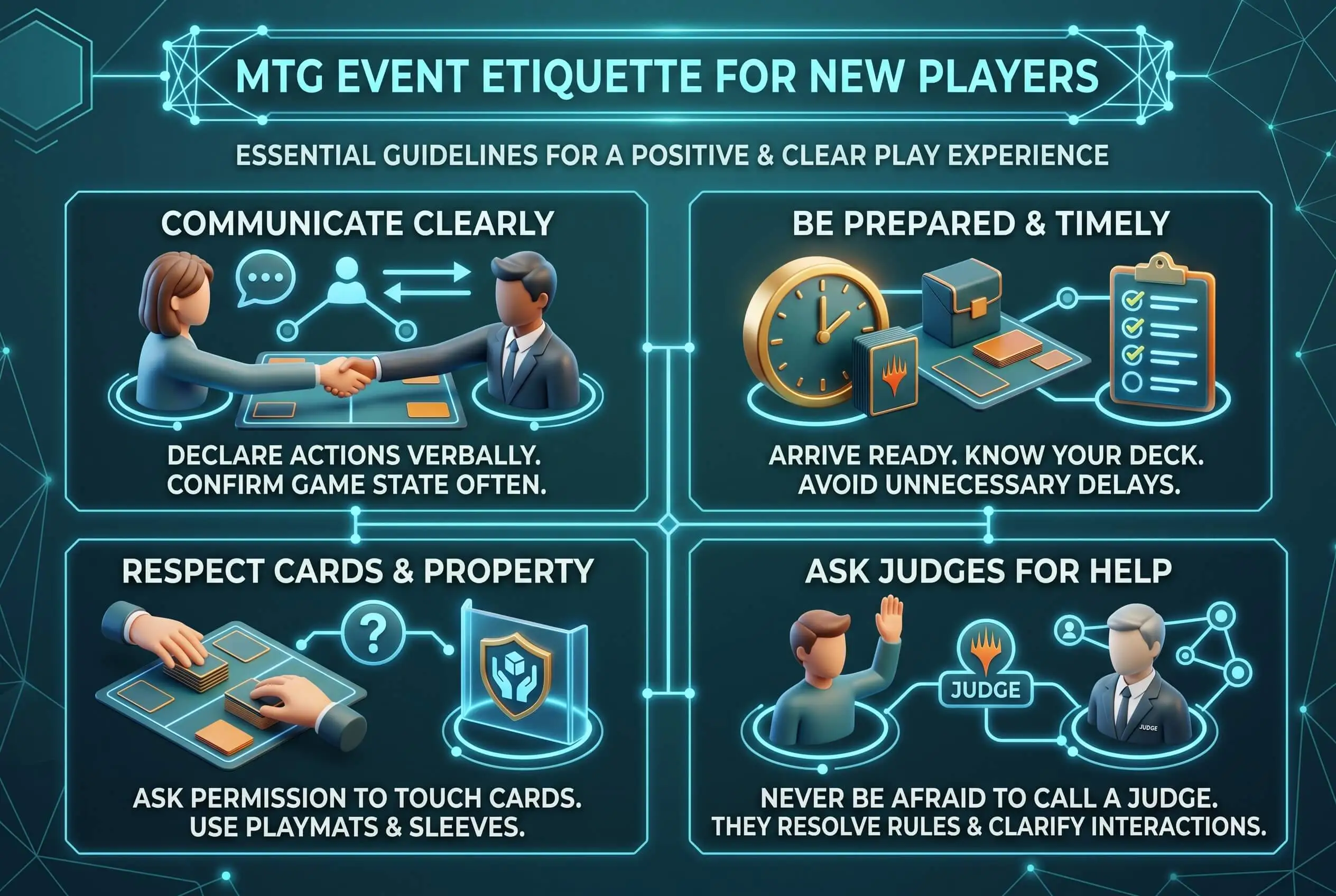
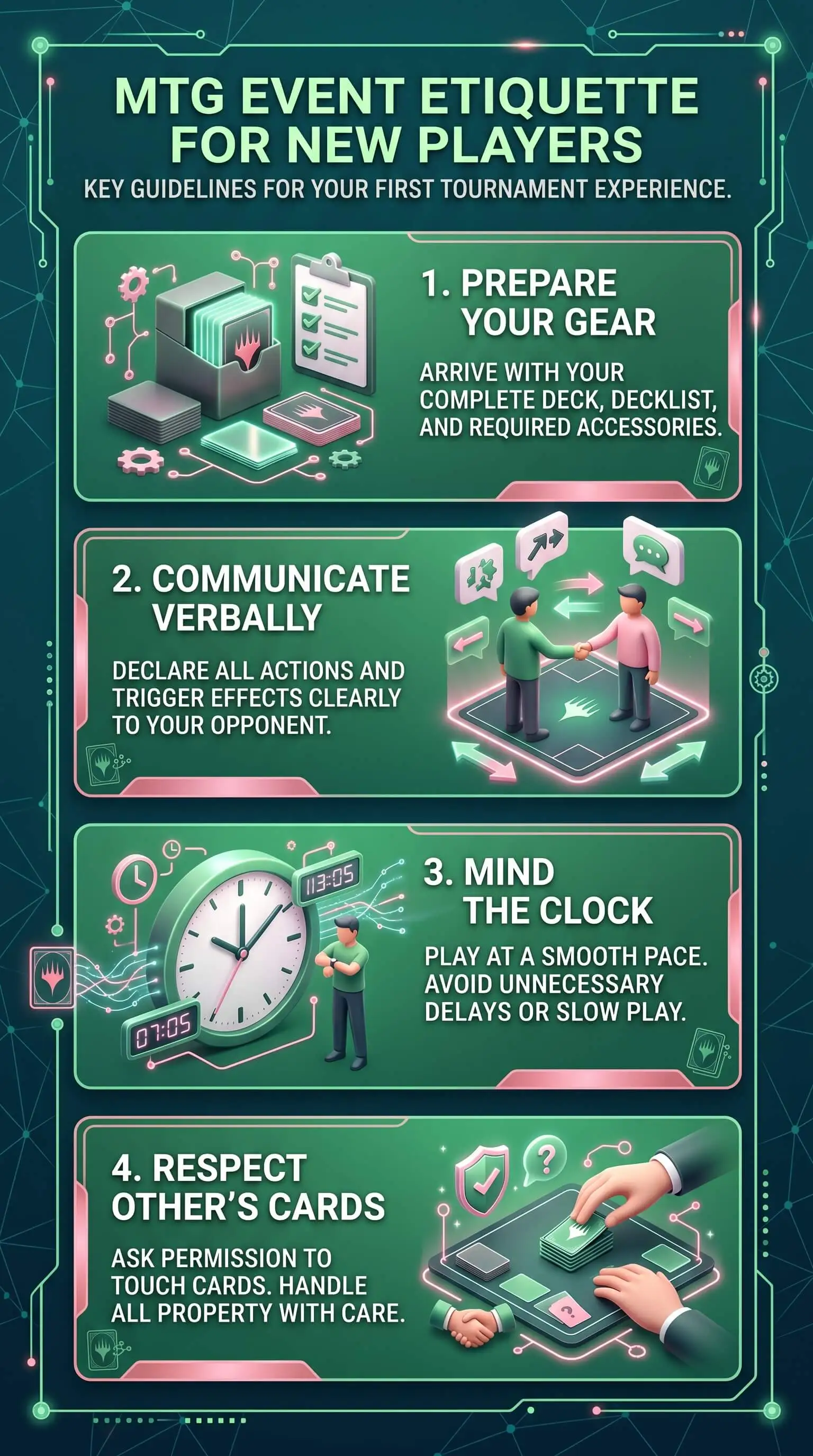
Never touch your opponent's cards without permission. That includes the deck, the sleeves, the tokens, and any dice they brought from home. Breaking that rule will get you side-eye at any competitive table. If you need to see a card in their graveyard, ask politely and wait for them to turn it toward you.
Read your cards out loud so your opponent understands the effect. Nobody has all 20,000-plus Magic cards memorized, and reading the text aloud is what serious players do at the table. Showing the card builds trust between opponents and prevents disputes later in the game.
At a serious event, don't eat at the table. Spills on someone's expensive deck create a problem nobody wants to fix. Keep a sealed water bottle nearby and save snacks for the break. Avoid commenting on neighboring games, even with encouragement, because it counts as a distraction to the players in that match. When a rules question comes up, call a judge. The judge is the authority on rulings at sanctioned play, and players across the table, spectators with strong opinions, and forum threads from last night don't override their ruling.
Commander pod etiquette
Commander runs on what the community calls a social contract. The format is built for four-player, multi-hour games where the goal is fun first and winning second. That shifts how you should behave at the table.
Before you shuffle up, talk about your deck. Mention the power level, the general strategy, and any combos that could end the game early. A casual pod doesn't want to lose to an infinite combo on turn four. Match the energy of the people you're playing with. If three players brought casual decks and you brought a cEDH list, swap it out for something closer to their level.
Welcome new players patiently. Don't groan when someone asks what a card does, and don't mock unfamiliar jargon. The people who get invited back to Commander pods are the ones who help newcomers learn the format. If you become an early target because your board state looks threatening, don't take it personally. That's the format. The politics shift quickly once the threat profile changes.
What to bring to your first event
Bring your deck in sleeves, ideally inside a deck box. A playmat protects your cards and gives you defined space on the table. Carry dice for tokens and counters, or use a digital life counter app on your phone. A pen and small notepad helps if you'd rather track life on paper. Water in a sealed bottle. Snacks if the event allows them. Showing up prepared signals respect for everyone else's time, and it means you won't have to borrow from the player next to you for three hours.
Hygiene matters more than you think
This part isn't a joke, and the community talks about it openly. Magic events run several hours in close quarters at the same table, which makes personal hygiene a real consideration for everyone in the room. Shower within 24 hours of the event. Brush your teeth, or keep mints on hand. Use deodorant if your body needs it after a long day. Wear clean clothes that fit the venue. That usually means casual, but skip anything overly revealing or aggressive in messaging, because kids and families come to Friday Night Magic too.
“A judge I know who's worked Friday Night Magic events at three local stores in my area put it to me this way: "After years of running FNM, the players I see come back week after week aren't the strongest deckbuilders. They're the ones who shuffle thoroughly, communicate clearly, and treat opponents like fellow humans. Skill brings you to the table once, but etiquette is what keeps you there." That tracks with what I've watched play out at the LGS over the years. The strongest players in any local scene aren't always the most welcome at the table. The most welcome are the ones who make the game feel good for everyone else playing, which is its own form of personal brand development within the community.”
7 Essential Resources
Wizards of the Coast Magic: The Gathering Rules, the official rules hub for sanctioned play.
Magic: The Gathering on Wikipedia, full history, formats, and gameplay background.
r/magicTCG on Reddit, the largest active community for ongoing etiquette discussion and player advice.
Commander Rules Committee Philosophy, the social contract that shapes Commander play.
Wizards Play Network Store and Event Locator, the tool to find sanctioned Magic events at participating stores near you.
EDHRec, Commander deck data and community averages to help gauge pod power levels.
MTGGoldfish, meta tracking, deck pricing, and competitive format insights.
3 Statistics
Magic: The Gathering brought in $1.72 billion in revenue for fiscal year 2025, making it the strongest year for the brand in its 33-year history. (Hasbro Investor Relations)
The average tabletop Magic player is around 30 years old, with the majority of the player base falling between 13 and 45 years old. (Hasbro Investor Relations)
The Wizards Play Network supports a community of more than 6,000 game stores worldwide that host sanctioned Magic events. (Wizards of the Coast Magic Support)
Final Thoughts and Opinion
I've come to see etiquette less as gatekeeping and more as the floor everyone stands on at the table. The Magic community gets a bad rap sometimes, and most of it isn't earned. Most of the players I've met want newcomers to enjoy the game. Most of the friction at events comes from small habits that take five minutes to fix.
You're going to mess up at your first event. Everyone does. You'll forget to present your deck for a cut, you'll reach for an opponent's card without thinking, or you'll talk during somebody's turn while debating magic the gathering mtg digital life counter app vs physical options. Apologize, adjust, keep playing. The community rewards good-faith effort. What earns respect at a Magic event has less to do with winning than with how you treat people and whether you leave the table better than you found it.
Frequently Asked Questions
What is the most important MTG event etiquette rule?
Never touch your opponent's cards without permission. That single rule prevents most disputes at any competitive table. Their deck, sleeves, tokens, and dice belong to them. If you need to see something, ask politely and wait for them to show you.
Should I say "good game" after every match of Magic: The Gathering?
Say it when you mean it. As the loser, extend your hand first and say it sincerely. As the winner, read the room. If your opponent seems frustrated, a simple "thanks for the match" can land better than "GG." The goal is genuine respect at the table, not a reflex line.
How is Commander etiquette different from Standard MTG etiquette?
Commander is more social and runs on a social contract. Players discuss decks before the game, match power levels, and accept that politics and gang-ups are part of the format. Standard play is more individual and rules-driven. Both require the same baseline respect for the people at the table.
What should I bring to my first MTG tournament?
Bring your deck in sleeves and a deck box, a playmat, dice or a digital life counter, a pen and notepad, and a sealed water bottle. Snacks are fine for breaks. Show up prepared so you don't borrow from neighbors all day.
Can I touch my opponent's cards in Magic: The Gathering?
No, not without explicit permission. Even to flip a card near you, ask first. If you need to see something in their graveyard, ask politely and let them turn the card toward you.
How do I handle a rules disagreement at an MTG event?
Call a judge. Don't argue with your opponent and don't ask spectators. At a sanctioned event, the judge's ruling is final. Judges are trained to handle exactly these situations without anyone at the table feeling targeted.
Do I really need to shower before an MTG event?
Yes. Magic events run several hours in close quarters, and personal hygiene is something the community has discussed openly for years. Shower within 24 hours, brush your teeth or carry mints, and use deodorant if your body needs it.